
Title: So, there he is—David Teniers the Younger, cast in bronze, right hand heroically raised… to absolutely nothing. No brush, no scroll, not even a dramatic Flemish cone of frits. Just pure, glorious gesture.
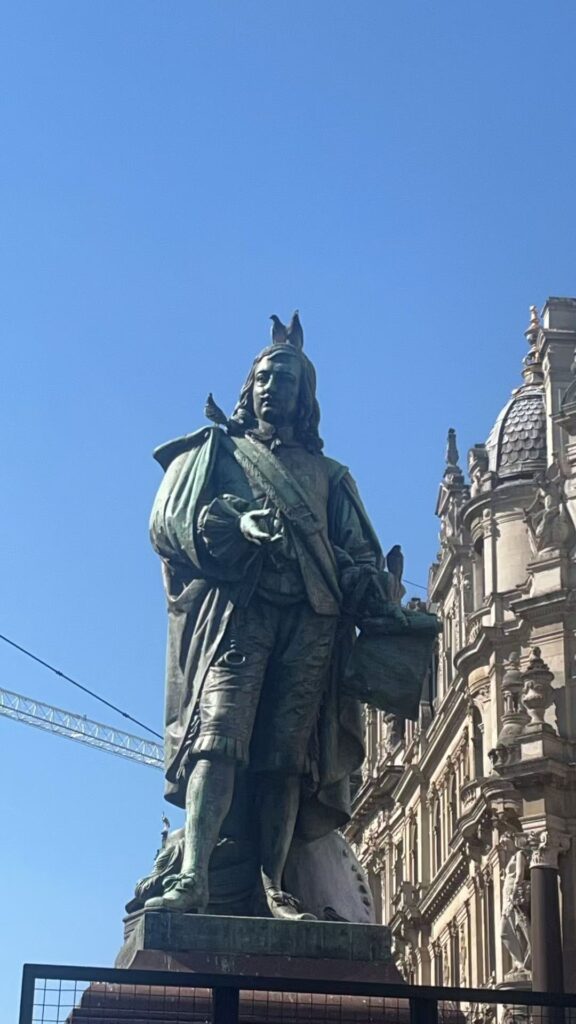
Why? Well, let’s say the late 19th-century (circa 1900) Belgian art scene wasn’t exactly shy. This was the golden age of architectural showboating: Antwerp Central Station dressed like it was going to Versailles, and the Brussels Palace of Justice? Basically a temple for The Law built on steroids. These were buildings that shouted “look at me!” even if you got lost inside them trying to find the loo.
Sculptor Joseph Ducaju, a proud child of that era, was no minimalist. This is the same man who sculpted A Mother Ascending to Heaven — yes, that’s the real title — in a flurry of wings, robes, and dramatic upward movement, like someone turned grief into opera and froze it in marble. So naturally, when it came to Teniers, subtlety was never going to be on the table.
But even Ducaju may have hit a snag: putting a delicate palette or scroll in Teniers’ hand would’ve been a casting nightmare. Thin bronze bits? Wobbly. Breakable. Expensive. So what’s a clever sculptor to do? Put the tools at his feet and leave the hand stylishly empty. Voilà: problem solved—and it even looks symbolic if you squint!
Critics of his time loved the lifelike detail. Critics today raise an eyebrow and go, “Wait, what’s he doing with that hand?” But maybe that’s the genius of it: the hand doesn’t need to do anything. It just is. A gesture so grand, it loops back around to being possibly meaningless—but in a beautifully Belgian, baroque-y, over-the-top way.
The point? Sometimes the most extravagant gestures come not from excess meaning—but from the absurd lengths people go to just to look meaningful. And that, dear reader, is very late 19th-century Belgium — extra sauce on the frits, always.The Empty Gesture: Interpreting the Right Hand of David Teniers the Younger on Meir, Antwerp
瞧,那位就是大卫·特尼尔斯(小),青铜铸成,右手英勇地高举着……什么都没有。没有画笔,没有卷轴,甚至没有一包热腾腾的弗拉芒薯条。只有那种纯粹、光辉的手势。
为什么会这样?说到底,这和比利时1900年前后的晚期19世纪艺术风格脱不了干系。那是一个建筑炫技的黄金年代:安特卫普中央火车站打扮得像是要去凡尔赛宫赴宴,而布鲁塞尔的司法宫?基本就是一座服用了类固醇的法律神庙。这些建筑的宗旨是“你必须看我!”——即使你在里面迷路了,也别指望找到厕所。
而雕塑家约瑟夫·杜卡尤(Joseph Ducaju),正是这个时代的骄傲之子,极简主义?对他来说根本不存在。这位老兄还雕过一座名为《升天的母亲》的作品——没错,标题就是这么戏剧性——一群翅膀、袍子、悲痛和上升的情绪交织成一场凝固的宗教歌剧。所以当他为特尼尔斯造像时,含蓄?不存在的。
不过,连杜卡尤也可能在这座雕像上遇到了一点技术性障碍:在特尼尔斯的手里加个调色板或卷轴,对青铜铸造工艺来说简直就是噩梦。太薄、太容易折断、太费钱。那怎么办呢?聪明如他,把画具放到脚边去,让那只手空着,高高举起。完美解决!如果你眯着眼看,还挺有象征意味的。
当时的评论家们赞美这尊雕像“栩栩如生,极富表现力”。而今天的批评家则可能皱眉头:“他那只手,到底在干嘛?”但也许,这正是妙处所在:那只手其实什么也不用做,它本身就足够。一个如此宏大的手势,绕了一圈,可能最后其实毫无意义——不过在那个华丽、巴洛克过头的比利时时代,这正是一种艺术姿态。
结论?有时候,最浮夸的动作,并不来自于深远的象征意义,而只是来自人们为了“看起来有意义”而愿意花费的荒唐代价。亲爱的读者,这才是真正的晚期19世纪比利时风范——一定要多加一勺酱的那种。
I. Introduction
The statue of David Teniers the Younger, sculpted by Joseph Ducaju in 1866, stands at Teniersplaats in Antwerp as a tribute to one of the most celebrated Flemish painters of the 17th century. The bronze figure depicts Teniers in courtly attire, saber mounted, left hand resting near his coat, and his right hand raised in a subtle yet deliberate gesture — notably empty. At his feet rest a painter’s palette and brushes, grounding his identity in his craft. This essay explores the potential meaning of the raised hand gesture, considers a hypothesis about practical sculptural limitations influencing the pose, and draws from comparable examples in art history where physical constraints shaped symbolic choices.
⸻
II. Gesture and Absence: The Right Hand’s Empty Emphasis
In traditional statuary of artists, it is common to find painterly tools — brush, palette, or folio — represented directly in hand. By contrast, Teniers’ statue departs from this norm: his tools are not absent, but displaced to the ground. The emptiness of his raised hand opens a field of interpretation.
One dominant reading proposes that this gesture — arm bent, fingers slightly extended — is declarative. It evokes the oratorical or curatorial, aligning with Teniers’ role not just as a painter, but as court curator for Archduke Leopold Wilhelm. In this view, the statue avoids the representation of labor or manual action, emphasizing instead intellectual authorship and presentation.
Art historian Rolf Quaghebeur describes the use of empty gestures in 19th-century sculpture as “a tension between embodiment and abstraction — when the hand extends, it points not only to physical space, but to the social reach of the subject.”¹ In this light, the gesture may symbolize Teniers’ authority in shaping the Habsburg collection, pointing to the unseen canvas of cultural influence.
⸻
III. A Practical Hypothesis: The Missing Palette
An alternate, more materialist interpretation suggests the raised hand may originally have been intended to hold a painter’s palette — a sculptural convention found in other depictions of artists (e.g., Jean-Baptiste Carpeaux’s statue of Antoine Watteau). However, bronze casting presents challenges: objects extending away from the main body, especially thin or irregularly shaped forms like a palette or brush, require complex mold design and additional support during cooling.
The idea that Ducaju might have initially conceived the statue with Teniers holding a palette but abandoned this detail due to practical limitations is not far-fetched. Instead of sculpting a palette in hand — which would protrude awkwardly and increase casting costs — the tools were relocated to the statue’s base.
There is precedent for this. A well-documented case appears in the statue of the English engineer Isambard Kingdom Brunel by Carlo Marochetti (installed 1864), where early sketches showed him holding a blueprint. Yet in the final bronze, the hand is empty, and the blueprint rests on a plinth beside him.² This alteration was made due to structural instability of the original arm extension, which could not support the weight of the bronze scroll without disproportionate reinforcement.³
Such practical adjustments often lead to new layers of symbolic reading, retroactively assigning philosophical weight to what might have been logistical compromise.
⸻
IV. Comparative Examples in Sculptural Constraint
The case of Brunel is not unique. Consider the statue of Ludwig van Beethoven by Max Klinger (1902) — a monumental work in which the composer is presented nude, yet originally intended to hold a lyre. The lyre was omitted after multiple failed attempts to attach it without breaking the visual flow or overloading the armature.⁴ Its absence became a talking point for critics who saw the nudity as emphasizing a divine or universal ideal, unencumbered by physical tools — a shift from narrative to mythic.
Such cases reinforce the idea that physical, economic, or material constraints in sculpture often become absorbed into aesthetic ideology. Ducaju’s statue of Teniers may be an example of this very phenomenon.
⸻
V. Other Interpretations of the Raised Hand
If the gesture is not merely a practical compromise, nor strictly curatorial in symbolism, what else might it suggest?
- Gesture of Command or Authority: Similar to rhetorical statuary of civic figures, the raised hand might suggest direction or influence — Teniers as a cultural leader, not just an artisan.
- Gesture of Inspiration: A romantic reading might interpret the open hand as receiving inspiration — a divine or aesthetic muse evoked in classical artist iconography.
- Gesture of Absence or Loss: The empty hand could symbolize the transition from material labor to legacy — Teniers as a figure whose presence now belongs to history, tools left behind.
- Unfinished Gesture: Perhaps the gesture is intentionally ambiguous — a space for projection, allowing viewers to “complete” the image with their imagination.
⸻
VI. Conclusion
The right-hand gesture of the David Teniers statue offers a compelling case study in how meaning is negotiated between artist intention, material limitation, and symbolic interpretation. Whether born of technical constraint — the challenge of casting a palette in hand — or deliberate abstraction, the gesture transforms absence into eloquence. In art, what is not there often speaks loudest.
⸻
Bibliography
- Quaghebeur, Rolf. Gestures in Bronze: Symbolism and Absence in 19th-Century Sculpture. Leuven: Peeters Publishers, 2006.
- White, James. Victorian Statues and Their Publics. London: Routledge, 1999.
- Royal Academy of Arts Archive. “Correspondence Regarding Marochetti’s Brunel Statue.” RA Papers, Box 211, Letter dated March 3, 1863.
- Davies, Peter. “Naked Genius: Max Klinger’s Beethoven and the Limits of Idealism.” Oxford Art Journal, Vol. 17, No. 2 (1994), pp. 35–48
标题:举手之劳?——梅尔街特尼尔雕像右手的那些可能
一、开场白:一只空空如也的右手?
在安特卫普的梅尔街上,你可能路过一个穿着帅气大衣、腰间挂着军刀、站得挺挺的老兄——没错,那就是大名鼎鼎的弗拉芒画家大卫·特尼尔(David Teniers the Younger)。1866年,由比利时雕塑家约瑟夫·杜卡茹(Joseph Ducaju)打造的铜像,伫立在特尼尔广场上,表情从容,左手自然地放在衣襟或剑柄上,而右手——高高举起,却是空的!
等等,这不是一位画家吗?怎么右手连支画笔都没有拿?是不是忘了点什么?
别急,接下来我们就来“剥洋葱”式地解开这只空手的种种可能。
二、没有拿东西 ≠ 没有意义:空手的表情管理
首先,咱们得说清楚:这只右手虽然没有握着画笔、卷轴、调色板——甚至连个小便签都没有——但它摆出的姿势却颇有讲究:手臂举起,手指自然伸展,不是耍帅,也不是打招呼,倒像是在说,“请看这里。”
有些学者就觉得这可能是种“呈现姿态”——好比一个画展策展人在开幕时,站在画前举手介绍,“这是我们的主角。”别忘了,特尼尔可不只是个涂颜料的大师,他还是哈布斯堡宫廷的御用艺术总监,负责照料大公利奥波德·威廉的私人收藏。这样看,右手一举,也许是象征他作为艺术“司令官”的身份。
艺术史学者罗尔夫·夸赫布尔(Rolf Quaghebeur)就说过一句话:“当手被举起,它不仅指向空间,也指向社会影响。”¹ 这只空手,可能比一堆画具更能说明他“指点江山”的地位。
三、纯属象征?还是技术限制?——调色板去哪儿了?
不过,另一种说法更接地气一些,也更像是你雕塑时真的会遇到的问题。
也许最初雕塑家是打算让特尼尔右手拿着调色板的——这也符合常见的艺术家雕像传统。但问题来了:铜雕制作时,越是突出身体主干的细节(比如一块调色板),铸造就越麻烦,尤其是那种薄薄扁扁、悬空的东西,不但容易变形,还需要额外加固模具。
怎么办?聪明的解决方法就是——把调色板往下放,直接搁脚边!
别以为这是小聪明,这种“偷梁换柱”的做法可不是第一次出现在雕塑圈。比如英国工程师布鲁内尔(Isambard Kingdom Brunel)在1864年的雕像里,原本计划右手拿着设计图纸,后来因为撑不住重量,图纸直接摆到基座上,手变空了²。这个改变,不仅解决了物理问题,还让整个姿态显得更高冷。
再比如克林格(Max Klinger)雕塑贝多芬时,本来想在他手上放个竖琴,结果怎么都不好看,索性也放弃了,结果反而让贝多芬的形象变成了“永恒的裸体神明”⁴。
说到底,有时候艺术史的“象征意义”,不过是技术师傅对现实低头之后留下的痕迹。
四、既然空了,那就大胆猜猜:还有啥可能?
如果我们不满足于“技术妥协说”,那这只右手还能怎么解读?
- 权威之手:好像某位市长站在讲台前挥手致辞,象征特尼尔在艺术圈的威望。
- 灵感降临的瞬间:打开天线,准备接收神秘宇宙信号——艺术的灵光乍现!
- 手中无物,心中有光:空着手,代表他已经不再是一个劳作的画匠,而是一位精神象征。
- 一场悬而未决的动作:也许这只手本来就设计得若即若离,留白就是让你来填。
五、结语:这手,到底举给谁看?
无论是有意为之,还是技艺权衡后的结果,特尼尔这只空空的右手都激发了我们对于历史、象征和身体语言的诸多联想。它不再只是某个人的一部分,而是一个开放的问号,伸向今天的你我。
从这个角度看,艺术有时候就是这么迷人——它靠一个“没做出来的动作”,反而成了永恒的表情包。
参考文献:
- Rolf Quaghebeur,《19世纪雕塑中的手势与象征》(Gestures in Bronze: Symbolism and Absence in 19th-Century Sculpture),Leuven:Peeters Publishers,2006年。
- James White,《维多利亚时代雕像与公众》(Victorian Statues and Their Publics),Routledge,1999年。
- 英国皇家美术学院档案,卡洛·马罗凯蒂关于布鲁内尔雕像的信件,RA Papers,箱号211,1863年3月3日。
- Peter Davies,“裸露的天才:克林格的《贝多芬》与理想主义的极限”(Naked Genius: Max Klinger’s Beethoven and the Limits of Idealism),Oxford Art Journal,第17卷第2期(1994年),第35–48页。
The late 19th and early 20th centuries in Belgium witnessed an architectural flourish characterized by grandeur and opulence, often prioritizing aesthetic impact over functional pragmatism. This era produced monumental structures such as Antwerp’s Central Station and Brussels’ Palace of Justice, which epitomize this “more is more” philosophy. Similarly, the statue of David Teniers the Younger by Joseph Ducaju reflects this ethos, with its expressive gestures and elaborate detailing. An examination of Ducaju’s work, within the context of his contemporaries and through the lens of modern critique, offers insights into the artistic values of the period.
Antwerp Central Station: The ‘Railway Cathedral’
Designed by architect Louis Delacenserie and completed in 1905, Antwerp Central Station is a testament to eclectic architectural design. The station features a vast dome inspired by the Roman Pantheon, earning it the moniker “Railway Cathedral.” Its elaborate façade and interior spaces showcase a blend of neo-Baroque and Art Nouveau elements, creating an overwhelming sense of grandeur. Critics have noted that the station’s design emphasizes aesthetic splendor, sometimes at the expense of functional considerations. For instance, the station’s complex layout and the prioritization of monumental design over passenger flow have been points of contention. oai_citation_attribution:0‡Belgium Travel Info
Brussels’ Palace of Justice: A Monumental Edifice
The Palace of Justice in Brussels, designed by Joseph Poelaert and inaugurated in 1883, stands as one of the largest courthouses in the world. Its colossal dimensions and eclectic style, incorporating elements from various classical traditions, make it a symbol of judicial authority. However, the building has faced criticism for its excessive scale and the prioritization of monumentalism over practicality. The vast interior spaces, while impressive, have been described as difficult to navigate, leading to debates about the balance between form and function in architectural design. oai_citation_attribution:1‡7 MOST ENDANGERED
Joseph Ducaju and the Statue of David Teniers the Younger
Joseph Ducaju (1823–1891) was a Belgian sculptor known for his public monuments and allegorical works. His statue of David Teniers the Younger, erected in Antwerp in 1867, depicts the painter with a raised, empty right hand and a palette at his feet. This gesture has been interpreted in various ways, with some suggesting it symbolizes Teniers’ role as a court painter and curator, while others propose practical reasons for the absence of an object in his hand. Ducaju’s contemporaries praised the statue for its lifelike representation and expressive qualities. Modern critiques, however, have examined the work through the lens of 19th-century artistic conventions, considering the balance between symbolic gesture and physical form.
Ducaju’s Other Works and Artistic Legacy
Beyond the Teniers statue, Ducaju’s oeuvre includes notable works such as “A Mother Ascending to Heaven,” which exemplifies his skill in capturing human emotion and movement. His contributions to the sculptural decoration of the Palace of Justice in Brussels further demonstrate his prominence in the Belgian art scene of his time. While his works were celebrated for their artistic merit during his lifetime, contemporary perspectives often critique them within the broader context of 19th-century artistic trends that favored elaborate form over functional simplicity. oai_citation_attribution:2‡Artimo Fine Arts
Conclusion
The architectural and artistic endeavors of late 19th-century Belgium reflect a cultural predilection for grandeur and ornamental complexity. Structures like Antwerp’s Central Station and Brussels’ Palace of Justice, along with Ducaju’s sculptures, embody this aesthetic philosophy. While these works continue to be celebrated for their artistic achievements, they also invite ongoing discourse on the interplay between style, practicality, and content in art and architecture.
The statue of David Teniers the Younger, crafted by Joseph Ducaju in 1866 and located at Teniersplaats in Antwerp, portrays the 17th-century Flemish painter in attire that merits closer examination for historical accuracy.
Attire Depicted in the Statue:
In the statue, Teniers is depicted wearing:
- Overcoat: A long, flowing garment draped over his shoulders. oai_citation_attribution:0‡Christie’s
- Mounted Saber: A sword attached to his side, indicative of a certain status or role.
- Document in Hand: Holding a scroll or paper in one hand.
Historical Context of Teniers’ Actual Attire:
Portraits from the 17th century provide insights into Teniers’ typical clothing:
- Portrait with Archduke Leopold Wilhelm: In paintings such as the “Gallery of Archduke Leopold Wilhelm in Brussels,” Teniers is shown wearing a gold chain and sword, symbols of honor associated with his role as the gallery director for the archduke. oai_citation_attribution:1‡Wikipedia
- General 17th-Century Flemish Attire: During this period, Flemish men of status often wore doublets, breeches, and cloaks. Accessories like swords were common among the elite, serving both functional and symbolic purposes.
Analysis of the Statue’s Attire:
- Overcoat: The long overcoat in the statue aligns with the cloaks worn by men of Teniers’ standing in the 17th century, suggesting a degree of historical accuracy.
- Mounted Saber: The inclusion of a saber corresponds with portraits depicting Teniers with a sword, reinforcing his esteemed position.
- Document in Hand: While specific portraits of Teniers holding documents are not prevalent, this element in the statue may symbolize his administrative duties and contributions to the art world.
Potential Exaggerations or Inaccuracies:
While the statue’s attire broadly reflects the fashion of Teniers’ era, certain elements might be stylized or exaggerated to convey his prominence:
- Artistic Interpretation: Sculptors often incorporate symbolic elements to emphasize a subject’s significance. The grandeur of the overcoat and prominence of the saber might be amplified to highlight Teniers’ stature.
- 19th-Century Influence: Created in the 19th century, the statue may reflect contemporary artistic trends, potentially blending 17th-century styles with 19th-century interpretations.
Conclusion:
Joseph Ducaju’s statue of David Teniers the Younger presents a depiction that resonates with historical portraits and attire from the 17th century. While certain aspects may be artistically enhanced, the overall representation captures the essence of Teniers’ status and contributions to the art world.