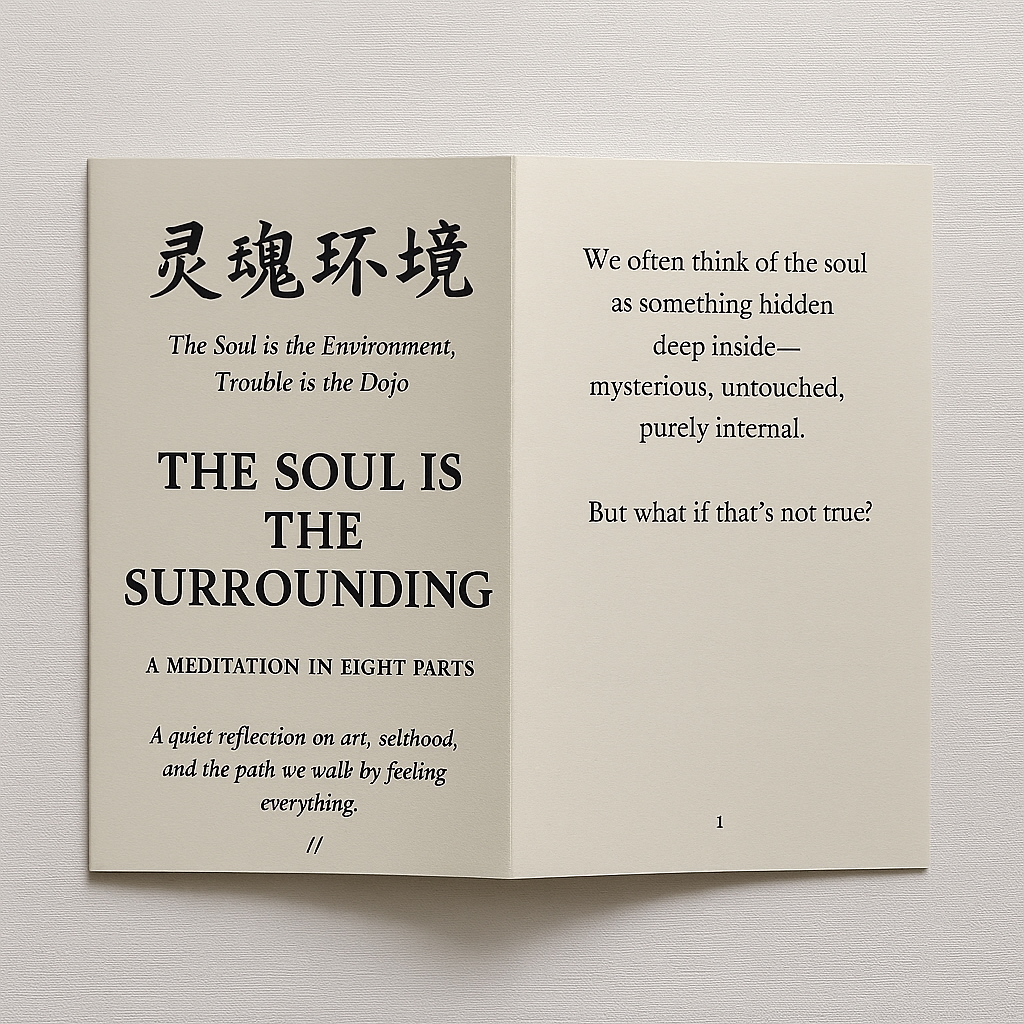
Soul as Surrounding, Trouble as Training: A Meditation on Presence and Growth
“灵魂是环境,烦恼为道场。”
The soul is the environment. Trouble is the dojo.
At first glance, this poetic line might seem to contradict the way we usually speak about the soul. We’ve long imagined the soul as something internal, hidden deep within — a private and mysterious core of who we are. But this line invites us to rethink that entirely. What if the soul isn’t something locked away inside, but rather something that extends outwardand surrounds us? What if it is not only a reflection of who we are, but also a space we’re actively shaping all the time?
To see the soul as our environment is to understand that who we are is not just how we feel inside, but how we inhabit the world. The tone of our voice, the way we move through a room, the silence we hold for someone else, the chaos or calm we create in our physical surroundings — all of it becomes soul. It is an atmosphere. A presence. A signature we leave on everything we touch. Our soul is in the spaces we live in, the way our room feels when the door opens, the kind of energy we carry when we step into a conversation. The environment is not separate from us. It is us. We tend to it, and it reflects us in return.
The second half of the phrase brings even deeper clarity. Trouble is the dojo. And that is not a complaint — it’s an awakening.
In Zen thought, the dojo, or “道场,” is not simply a training hall for martial arts. It’s the place where the Way is practiced. It’s sacred. It’s where discipline, awareness, and transformation unfold. To say that trouble is the dojo is to recognize that difficulty is not the thing that blocks the path — it is the path. We often think we grow in moments of peace and stillness, but the truth is, most of our real becoming happens in the middle of friction. Trouble is where we are forged. It’s where the theory becomes real. Anyone can feel enlightened in a quiet room with a candle and soft music. But who are we when the deadline’s closing in, when someone says something cruel, when we’re misunderstood, exhausted, afraid?
That is where the Way is walked. That is where patience is tested and kindness is revealed not as a mood, but as a choice. The dojo is made of heartbreak, anxiety, failure, delay. Trouble becomes the teacher. It provokes us not to destroy us, but to stretch us. And with each test, we begin to see where we are still clinging, still rigid, still reactive. Slowly, painfully, we change.
Together, these two truths — soul as environment, trouble as dojo — form a quiet cycle. As we grow through challenge, we reshape the soul. As we tend the soul, we shift the energy of our environment. And that environment, in turn, draws new lessons, new challenges, new spaces in which to practice. The loop deepens. The path continues.
This isn’t philosophy to recite and forget. It’s practice. Daily. Ordinary. It’s in how we clean our space, how we respond to irritation, how we forgive without needing to win. It’s how we hold ourselves when things fall apart. It’s the way we let the world sculpt us, without losing the shape of who we truly are.
The soul is not sealed off somewhere. It’s already here. In this room. In the air between you and everything else. And the trouble you face today? That’s the mat. That’s the dojo. That’s where the next part of your path begins.
If you’d like, I can also shape this into a printed poster, spoken word reading, or turn it into a small artist’s zine. Let me know what form you want to carry it in.
灵魂是环境,烦恼为道场
“The soul is the environment, and trouble is the dojo.”
—or—
“Soul surrounds us; troubles are where we train.”
🌌
“The soul is the environment” (灵魂是环境)
This flips the usual idea of the soul being some inner core. Instead, it suggests:
- The soul is not locked inside — it extends outward, becoming the space we create, the vibe we give off, the aura others feel when they’re around us.
- Our external surroundings — how we arrange them, what we allow in — mirror the condition of our soul.
- In Taoist and Chan/Zen thinking, there’s no hard boundary between self and world. If your soul is like your environment, then what surrounds you is also you.
- Your room.
- The people you choose to keep close.
- The silence you cultivate, or the noise you tolerate.
In this way, you build your soul by shaping your environment, and your environment in turn shapes you. There’s no separation.
⚔️
“Trouble is the dojo” (烦恼为道场)
This is a direct hit from Zen Buddhism. “道场” (dàochǎng / dōjō) literally means “place of the Way” — the place where one practices.
So:
- Trouble, suffering, anxiety — these aren’t distractions from your spiritual path.
- They are the path.
- 烦恼即菩提 — “Affliction is enlightenment.” The mess is the teacher.
Think of each challenge as a sparring partner in your dojo:
- Every mistake is a teacher.
- Every trigger reveals what’s still unsettled.
- Every heartbreak stretches your capacity for empathy.
- Every obstacle sharpens your form, your patience, your grace.
Without these troubles, there’s no training. Without the dojo, there’s no warrior.
💫 Together: A Spiritual Loop
So now imagine this:
- You shape your soul by tending to your environment.
- That soul/environment attracts or stirs troubles.
- Those troubles arise not as curses, but as calls to grow.
- You grow by practicing awareness, presence, humility — right there inside the dojo of trouble.
- And through that growth, your environment/soul shifts again.
It’s a loop of becoming — spiraling inward and outward.
🧘 Final Reflection
This line reminds us:
Don’t flee from discomfort.
Don’t wait for calm to practice stillness.
And don’t think of the soul as something hidden deep inside you —
It’s already here, in the way you move through the room, the way you speak, the silence you hold.
“灵魂是环境,烦恼为道场。”
The sacred is never elsewhere.
It’s here — in the mess, the mood, the moment.